They write in Romanian, you read German
by Daniel Rockenschaub3 min read
The site speaks a mix of Romanian, Slovak and German — and everyone still understands what's meant, right away. Koro, the chat built into Nexoro, translates messages live, in more than 50 languages.

On a job site one morning: a site manager who speaks German, a foreman who writes in Romanian, and an apprentice who only partly understands either. The conversation about the next step happens anyway — usually with hands, gestures, and the hope that everyone understood the same thing.
That works as long as nothing complicated is involved. When the question is which wall is load-bearing and which isn't, it stops being enough.
How you notice language is becoming a risk
A few signs repeat in teams with several native languages:
- Important instructions get given twice — once in German, once in broken English, hoping it lands the second time.
- Follow-up questions don't happen, not because everything is clear, but because the foreign language raises the bar too high.
- A note on site gets translated by the one person who happens to speak both languages — if they're out, the translation is missing too.
- A colleague gets pulled onto a call as an interpreter, someone who was actually scheduled for something else.
- An instruction is given correctly and still carried out wrong, because the translation got lost somewhere along the way.
None of these is an accident on its own. Together, they're the reason teams with several native languages work slower than the raw hours would suggest.
What it actually costs
Not understanding itself — with time and good will, that almost always worksout. What's expensive is the delay: the follow-up question that means a second drive back to the site. The work that has to be redone because the first instruction only half landed. And the colleagues who don't dare ask, because every question across the language barrier becomes its own small effort.
An instruction only half understood is as good as no instruction at all.
A simple check
How many native languages do the people on a typical job actually speak —from the site manager through the technicians to sub contractors? And: how many of them are genuinely confident in the language most instructions actually get given in? For most businesses with teams from several countries, the honest answer is: not everyone.
To be fair: a team that speaks only one shared language doesn't have this problem — translation doesn't solve a barrier that isn't there.
How this looks in Nexoro
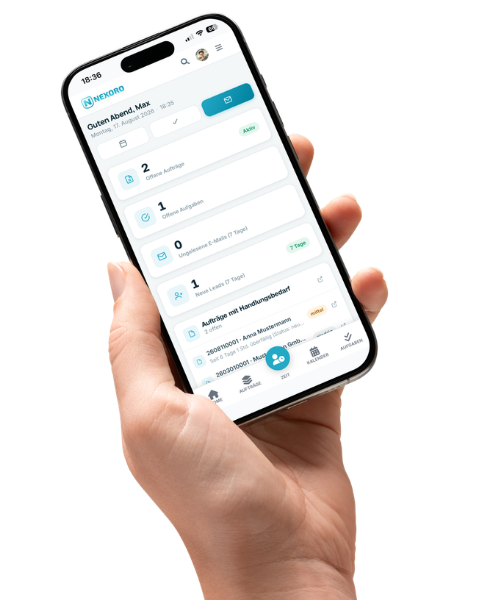
Chat in Nexoro runs on Koro, end-to-end encrypted for messages and calls, on phone, web and desktop. The notable part: Koro translates live, in more than 50 languages — a colleague writes in Romanian, the site manager reads the message in German, with nobody translating by hand. Translation happens server-side, without permanently storing the content. A chat message can turn straight into a task when needed — one that lands directly in the right job in Nexoro, instead of being typed again into a separate tool. If you want to know what that looks like for a team with several native languages, tell us which languages come together on your sites.